
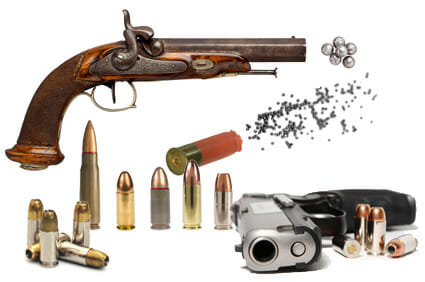
Lead Alloy bullets and Bullet Rounds
A lead bullet is a projectile. Thousands of years ago lead bullets were fired from slings but since the mid fourteenth century bullet has meant a projectile fired from a firearm. The original meaning of the word comes from the French “boulette” or “small ball” because early bullets were shaped that way and used gunpowder (“black powder”) for propellant.
Lead is an ideal bullet material because it is high in mass, relatively cheap, easy to obtain, easy to work and melts at a low temperature, making bullet manufacture easier.
Low speed bullets such as those fired from black powder, or muzzle loading firearms have been generally molded from pure lead, also know as musket lead. Such bullets are still made today for use in antique and replica fire arms.Since the invention of rifles and higher nuzzle speeds, bullets have been made out of several variations of lead alloys of tin and antimony . The typical bullet shape is now a pointed cylinder rather than a round ball.
Bullet types
There are several different uses for ammunition, such as military, law enforcement, hunting, marksmanship/target shooting, and self-defense, each requiring different bullet performance. There are also legal and public relations design considerations, such as lethality, threats to innocent bystanders, environmental impact, and appearance.
Most bullets are designed with a softer core, with a pointed tip, surrounded by a layer of harder metal called a jacket.
Bullets with tips designed for use in hunting, law enforcement and self defense often use softer tips that expand to cause maximum damage to incapacitate the target and tend not to completely penetrate so that bystanders are not harmed.
These types of bullets are banned from military use by convention. Military bullets usually have hard tips or full metal jackets.
Wadcutters are bullets with no point or a sharp shoulder behind the point used in target shooting to cut paper targets cleanly. Semiwadcutter bullets have a flat-tipped cone tip and can be used for target shooting, hunting, or self-defense.
Bullet Manufacture
There are many types of bullet manufacturers, ranging from large companies and governments to smaller custom ammunition manufacturers to individuals who load and reload ammunition with a few simple tools. There are also many different bullet designs and a lack of consensus about which is most effective. Because of this, there is no uniform method of ammunition manufacture.
The two most common bullet-forming methods are casting and swaging. Hollow points can be formed by either method. Machining includes any process where a machine is used to shape metal by cutting away portions. A typical machine used for bullets is a lathe. A lathe rotates the bullet metal against steel chisels to gradually cut away material.
For a complete listing of products available on this site, go to the products and services index page .