
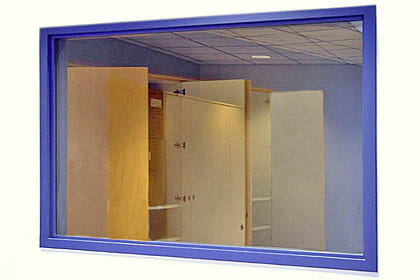
Lead glass or X-ray glass is a form of glass that has lead oxide inculcated into it during the manufacturing process.
Lead glass is effective for x-ray shielding and for other forms of radiation shielding due to the attenuation of ionizing photons as a result of lead’s high atomic number.
The attenuation of radiation increases as the mass density of the attenuating material increases, and also increases dramatically as the energies of the ionizing photons decrease. X-rays used in medicine, specifically diagnostic x rays, often have lower energies on the ionizing radiation spectrum, and are easily shielded by leaded glass. The lead glass used in windows often contains lead that creates an attenuation equivalent 3mm of pure lead.
Lead Glass is used when a clear view and radiation shielding is of absolute priority in diagnostic, therapy, isotopic or nuclear radiation sources – used for medical treatment, imaging, testing, inspection, experimentation or energy production.
Typical uses for Lead Glass and X-ray glass include the following:
Medical applications
- Viewing windows and insulating glazing for X-Ray rooms
- Screens for medical diagnostics – providing protection for doctors and technicians with no reduction in the quality of the observations
Industrial and Nuclear applications
- Protection windows in laboratories, radioactive storage stations, nuclear fuel development plants and reprocessing plants
- Lenses for safety goggles and protective screens for radiation testing equipment and for electron beam systems and plasma generators.
- Airport security X-Ray glass – provides protection from airport luggage inspection equipment.
Please click for lead glass technical data
Please click for additional lead glass application information
Lead Acryllic
Lead acrylic is made from an acrylic co-polymer resin into which lead is chemically introduced as a compound. Lead acrylic contains 30% lead by weight and has a constant density of 1.6 gm/cm.
For the same lead equivalent, acrylic/plastic has to be approximately five times thicker than lead glass – significantly reducing observation capabilities.
Acrylic shields provide shatter-resistant, versatile mobile barriers, modular control booths, window panes, and door glazing.
For a complete listing of products available on this site, go to the products and services index page