
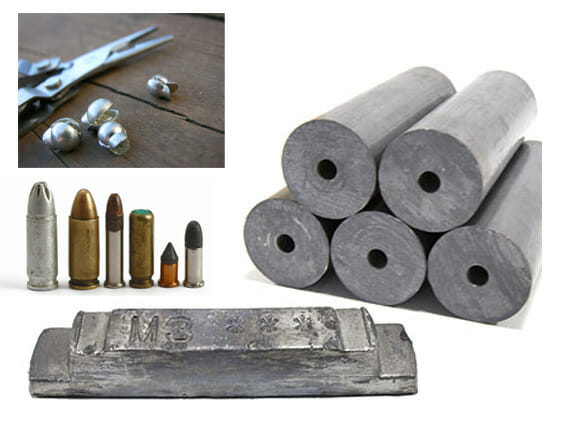
Lead ingots
Often lead ingots are purchased by enthusiasts who wish to cast their own items, such as lead bullets and lead fishing sinkers and other lead ballast applications.
Care should be taken when casting with lead. Melting lead and casting lead objects can expose you and others in the area to lead, which is known to be a health hazard. Protect yourself by using all available safety equipment. The fumes coming off the melting lead can be a significant health issue; therefore you should never melt lead without strong ventilation.
Lead ingots can be manufactured to required purity levels or as alloys of Antimony and Tin with defined properties. This can be specified so that the lead ingots meet the application requirements.
Lead Ingots for cast lead bullets
Hand-cast lead bullets go back hundreds of years before the appearance of jacketed bullets. In fact, until well into the 20th century, jacketed bullets were not as accurate as hand cast bullets.
Today, hand cast bullets are more likely to be used in hand gun shooting for reasons of cost and convenience due to the tremendous variety of shapes and sizes of molds available
While lead can be melted over a kitchen stove, an electric casting furnace is a lot more comfortable! Other than the correct mold, the only other equipment you’ll need is a sizer-lubricator with sizing die(s). This apparatus sizes the bullet to the correct diameter and perfect roundness and fills the bullet’s lube grooves with lubricant.
It is a good idea to add Antimony and Tin to the bullets making an alloy with 10 parts lead to 1 part Antimony and Tin. This will produce good hard bullets.
Lead ingots for lead sinkers
There are two main reasons for making your own lead fishing sinkers:
- Economics: it is cheaper especially if you tend to lose a lot of sinkers
- Design flexibility: Often it is hard to get exactly the kind of sinker that meets your needs or you may have a new idea that you want to try out.
The first thing to so is to get the lead molten to the point where it flows freely, but there are no bubbles. Lead melts at 612 degrees so you need a strong heat source to keep lead in a good fluid state. Any impurities will float to the surface and can be ladled off, one reason for using lead ingots is that the impurities can be controlled by the manufacturer so that you do not have to.
Other applications for lead ingots include lead ship ballast and model making.
Please click for Lead ingot information
For a complete listing of products available on this site, go to the products and services index page .